Showing posts with label books vs. e readers. Show all posts

Friday, August 16, 2013

Love That New Book Smell


Recently I read a blog post by a writer
 Jill Smolinki,  who says she does not keep many books in her house. I’m stymied. I have never met a writer who wasn’t a bit of a book hoarder.

 http://www.jillsmolinski.com/heythere/2012/9/14/do-you-hoard-books.html
Granted some of us now use e readers. I read in any format: books, e books, clay tablets. When I was in college, living in a small apartment, I had stacks of books under my bed and inside my kitchen cabinets. Later, when my then boyfriend moved in, he explained the kitchen was for cooking; it was not a branch of the Columbus Public Library. He insisted we place food and dishes in the cupboards. But he and I were both big readers, so the stacks of books doubled. The only solution was to give some of them away.

I often reread books, so I tend to hold onto them. You can tell my favorites by the post-its sticking out from the pages, and the underlined passages. Being in the company of paper books soothes me the way others might be placated by sitting on a park bench on a sunny afternoon. Granted I love that, too, but nothing beats a rainy Saturday in a bookstore, relaxing in an overstuffed chair, poring through a stack of books to choose which will go home with you. But as the photo on Jill’s blog shows, one’s attachment to books can get out of hand without sufficient space.

On a design show once I saw how books can be used a decor by arranging them on the shelves by color. One of my living room shelves has books arranged by tones.
Don't they have a nice aesthetic? They blend well with the family photos. Books are family.

I recently spent ten days on business/vacation in Seattle, where I set aside time to visit Elliot Bay Books.  http://www.elliottbaybook.com/ I entered Nirvana: rows and rows of books, real ones, not a dressed up toy shop like Barnes & Noble. Call me old school, but this is what a bookstore is supposed to look like. I was on my way to SEA TAC and had dragged my rolling carry-on bag with me. A bookseller offered to hold it for me at the counter as I browsed. I looked for staff recommendations, and someone named Kenny has similar taste in books, so I picked up a few he liked. (I was hoping to meet him and talk books, but he was off that day.)

I spent two hours (and seventy dollars) inside the bookshop.  I picked out five books (one was a gift for Elizabeth.) Since my bag was full, I had to choose which books to ship home and allow myself one to read on the plane, and had the rest mailed home.

A few days after I got back from the Northwest, the package arrived from Elliot Bay. Inside were two carefully bundles wrapped in craft paper.. I took the parcels out of the box and set them on a bureau in my living room, where they sat for a day before I opened one. The other still remains an anticipated gift. Yes, it’s silly. I know which book is in there, but because it’s still wrapped, I look forward to the jolt I will get from studying its cover and contents.

There is an aesthetic to a paper book not found in digital format. I like the rough hewn paper, the fresh inky aroma of a new book. I like to flip back to the cover and study the cover art, or gaze at the author’s picture. Which can be done with an e reader, but not without jumping though a few fiery hoops. I kept forgetting the title of the book I just finished reading last night on my kindle, so each time I turned the device on I had to hit the home key to see which title appeared at the top. And forget about trying to find the cover illustration or the author pic.

All my kindle book smell the same.

Perhaps instead of new car smell, someone will come out with a fragrance of ‘new book smell’ we can spray around us as we clutch our e readers in our hands in bed at night.

For more on this see related post; http://bit.ly/12b77I1

Happy Writing ( and Reading).

Thursday, January 17, 2013

Is Print Dead?

Available now 


.
Shortly after Christmas I visited Barnes & Noble. I spent a lovely afternoon having a latte in the cafe and  browsing the shelves. I walked to the registers to pay for my purchases. As I stood in line, I perused the magazines racks near the counter, and was stunned by the banner across Newsweek: This is Our Last print issue. Something in me shifted; science fiction is no longer fiction.
 Those of you who subscribe to and read my blog regularly know of my ambivalence with emerging technologies, particularly in the book realm. I own several devices, and use them regularly. I composed The draft for this post on an iPad, so arguing against technology is moot. However, my argument is not to ban existing platforms, as is happening in this Texas library,  http://news.yahoo.com/library-without-books-bibliotech-open-193118588--abc-news-tech.html

Is this a trend? The library of the future?  Look at the accompanying illustration in the artcile. What do you notice about the people? There are none, only a series of screens and empty stools. The shadowy figure behind the desk is solitary. Does that mean libraries will not only do away with printed matter, but their staffs as well?


Libraries throughout the centuries have adapted to the needs of their clientele. Every few years the death of the library is predicted, yet libraries have demonstrated a perseverance and adaptability. Yet this latest shift could put a serious dent in library services.

(Bookstores, however, are experiencing a shakier fate. see

Probably a gazillion of us have some access to screen technology, be it a TV, computer, laptop, smart phone, e reader, or tablet. I use all of the above to some extent, yet there is an aesthetic to printed books not found with a digital version. Perhaps this reveals my age. I grew up in a time before reliance on cell phones dominated our lives, relatively un-tethered to friends and family if I ventured out alone. Now I can update my status 24-7 via Facebook, revealing what I ate for dinner , find the weather and upcoming TV listings on my phone, yet when I use my e reader, Big Brother knows what I am reading.

E readers are great for travel. When I take a trip more than three days long, I generally like to pack 3-4 books, which now that airlines charge us for every last speck of dust in our luggage, loading a variety of books on my Kindle makes sense. The device is about the size of a trade paperback, and weighs about the same as a hardback book.

My Kindle is the second generation, which does not have a backlit screen, yet,  there are some issues with reading from backlit technology, particularly at night, the blue spectrum light emitted by screens interrupts sleep patterns. http://www.medicalnewstoday.com/articles/249592.php

This is bad news for those of you who like to curl up with your iPad or Kindle Fire and read in bed.  

 I don't hate technology. It enables me to write and post this readers in a variety of places, twitter, Google plus, and Facebook. In the old days, before blogging, when all opinion pieces  were printed through edited means, my ideas would be limited to cocktail hour chats or perhaps a letter to the editor. Now I can have a global dialogue and Instant access to feedback.

Another ironic bonus to technology is instant books.  I live an hour's drive from a brick and mortar bookstore, so if I need or want a book right away, I download it. Recently a publication where one of my stories appears (Triskaidekan,) was delayed by the printer, (see photo at top.) but the publisher posted an e book version, and I gained instant access to the anthology, which I was able to promote via social networking. Yet I still plan to also order a printed copy.

Ironically, readership is on the rise, yet print media are declining. It's the chicken or the egg. (Is digital downloading of books on the rapid rise due to vanishing bookstores, or are book stories vanishing because of digitalization? But this post isn’t supposed to be about bookstores…)  According to the Pew Research  Center , “The popularity of electronic books is increasing in the United States, with nearly one-quarter of American bibliophiles reading e-books, according to a survey released on Thursday…The number of e-readers aged 16 years and older jumped from 16 percent in 2011 to 23 percent this year, while print readers fell from 72 to 67 percent in 2012.”

But technology has its limits. Things break down. The power goes out, security leaks, files corrupted, devices get lost, or stolen, (who steals books anymore?) screens break, or go wonky. There are also economic issues.  . I live in Appalachia, where 45% of our students qualify for free and reduced lunched.  Many of our students in my HS still do not have access to computers and the Internet outside of school. Checking out books is free.


Lets hope the death of printed matter becomes, like the predicted death of radio with the advent of television, a shift n emphasis, where books and gadgets forge an alliance rather than declare war.

Please visit your local Library. Ask for information. Check out a book or other printed media. 

Thursday, September 6, 2012

The Odds Are Not Great Either Way


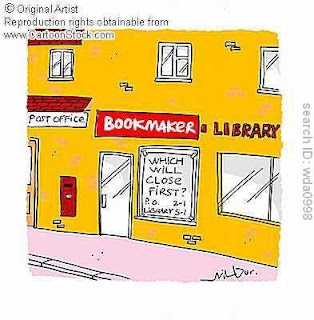
Recently my friend Thomas, a fellow librarian, posted this comic on Face book. I usually laugh heartily at Thomas’s postings, but this one is too true to be funny.

Given the ease and speed of e publishing, more “books" are being published than ever. A recent article by Mike Shatzkin points out, http://bit.ly/MW2knf ”half of the bookstore shelves that were available in the US in 2007 are gone by now.”

Handwritten letters are gifts; someone cared enough to sit down and share words of comfort, congratulations, birthday wishes, family news, or mail a postcard from Europe.  Who does that anymore?


Is print media dead?

I'm as guilty as the rest of you. I download books on my Kindle, and use Kindle and Nook apps on my phone and PC. But the nearest physical bookstore is an hour‘s drive from my house and sometimes I don’t want to wait two or three days to get a book in the mail from amazon, Powells or Barnes and Noble.


It's easy and fast to send e mail and catch up through social networking, yet it saddens me how the art of letter writing, handwritten cards and stamped paper envelopes may someday disappear.

Biographers often use old letters to carve out written portraits of their subjects. Through letters, authors are able to reproduce a subject’s voice, and recreate possible dialogue accurately. Imagine trying to track down electronic messages. For the past twenty years I have had numerous email accounts through my university days and several service providers. In the early days of the internet, service providers cropped up and disappeared with the seasons, so thousands of my communications are somewhere in cyberspace under addresses I no longer recall. Not that I will someday be worthy of a biography, but given the magnitude of social media, what will be worthy of existing in posterity?

Interesting how brick and mortar bookstores and libraries stores have only recently changed how they operate. While libraries still boast books as a major source of information, the shift toward multi media has not only oncreased circulation statistics, patrons expect to be able to find moivies, magazines, and music at the library. Similarly, patrons use library spaces for computer space.

For decades, books were the thrust of book stores. In the past few years I have noticed a trend toward games and gifts at the forefront and books displayed almost as an afterthought.

Books are my passion, one of the considerations for where to retire in three years is how many extant bookstores are nearby, yet

According yo Shatzkin, “One thing that will be different but similar in the rest of the world will be the decline of bookstores.”

Linda, another library colleague, suggested that maybe bookstores and/or libraries should have post offices and coffee shops in their lobbies. I love the idea of entities struggling to survive forge a symbiotic relationship. It happens in the natural worls all the time.

Meanwhile, the you can find world’s most interesting bookstores this site. They also sell hand crafted metal bookmarks and have links to lot of bookstore and library related stuff:


Your writing assignment this time is to write someone a letter or a card and mail it using snail mail. Then go visit the library.
Feel free to weigh in on this issue. Of course, you'll have to do it electronically, but there is room for multiple versions of comunication. When TV came out, people predicted it was the death of radio....
Happy Writing
@LauraMoewriter

Saturday, February 4, 2012

Monopoly Is a Dangerous Game

I have a love-hate relationship with the whole eBook thing; I love that I can instantly download a book on my kindle, yet I also feel a little ashamed. Yet now that my city no longer has a physical bookstore, and the selection at Walmart is limited, downloading and purchasing from Amazon has become a near necessity. However, those of us who love books and bookstores have an obligation to support independent stores and the remaining chains like Barnes & Noble. Otherwise, Amazon will monopolize the industry and deplete our choices.

Amazon, which opened its e doors in the 1990s, quickly became the world’s largest retailer due to its expert marketing strategies. Products are readily available, shipped with astonishing speed, and available worldwide. Recently, Amazon accommodated independent authors through its create space and KDP services, thus opening publishing venues to books the “big” publishers and agents refuse to look at. No matter how much or little an independent author sells his or her title, Amazon will provide a market, encourage options for marketing such as a free author page, open your title for reviews, all the while happily accepting its cut.

All is not rosy with Amazon. Recent issues of Harpers and The Writer have noted how Amazon openly acknowledges its goal is to create a publishing monopoly. They succeeded in helping Borders’s demise. Is Barnes & Noble next?

The benefit Barnes & Noble-and any independent bookstore- has over Amazon is human; you can walk into an actual store and get customer service. Try contacting a human at Amazon; it’s easier to break into Fort Knox. While Amazon customers can sit and browse, albeit online, the aesthetic of browsing quietly in a brick and mortar bookshop is missing. We mortals are social beings, and sometimes we crave the company of like minded people, people who love books and the stuff in bookstores. [see http://laura-moe.blogspot.com/2011/12/bookstore-is-wounded-not-dead.html]

Barnes & Noble now refuses to carry Amazon titles, which seems a little petty. But the book business has become like David and Goliath.
I was somewhat encouraged today when I visited a Barnes & Noble an hour’s drive from my house. It was crowded, and I had to wait in line.

Shop at Amazon. They provide remarkable access to an almost unlimited number of products. But also shop at independent bookstores (like Malaprops in Ashevile, NC or The Tattered Cover in Denver) and the extant chains. All of them have web sites. Yes, you’ll pay a little more, but those small shops also encourage independent authors to promote their books with readings and author talks in the store. Most of all, they provide personal service.


Happy writing and book shopping.

Monday, June 6, 2011

The Words Speak for Themselves

I am reading a book on my kindle called Bound to :Last: 30 Writers on Their Most Beloved books. In each chapter an author discusses his or her fondness for a particular book. Francine Prose focuses on the illustrations of a children’s book, while Ray Bradbury recounts a tale of how his adored aunt forced him to read )and love) Edgar Allen Poe. Each of the thirty authors in this book mentions the weight, texture, smell, and aesthetic of his or her favorite book. The irony that I am reading about books on an e-reader is not lost on me. Every book I read on my kindle weighs and smells the same. I can change the font size, and “book mark” electronically, but essentially every book I read on kindle looks the same. There are no slick, sexy covers, velvety pages, or color photos to grab my eye. If there are pictures in the book, on a kindle they resemble photos that survived a flood. So in order for a book to be memorable on an e-reader, the words have to matter. Books published on e-readers need to be better than those in print, so perhaps electronic publishing will raise the stakes, forcing writers to stick to telling us a really, really good story.

Here is a quote from another book I am reading (on my kindle.) "Grammar is like the air: someone higher up might try to set rules for using it, but won't necessarily follow the rules." from The Wind Up Bird Chronicles by Haruki Murakami

Happy Writing.