Showing posts with label bibliophiles. Show all posts

Saturday, December 27, 2014

“Days under bombardments, watching the shrapnel fly.”


This is not a review or recommendation of If on a winter’s night a traveler, by Italo Calvino, one of the most surreal novels I've encountered. Much of it seduces the reader in second person, making the Reader part of the bizarre quest for the ideal book. Like the film Inception, the novel doesn't make literal sense, its plot is not linear, and few people I know would have the patience to slog through it, yet throughout the story lay beautiful tidbits of prose about what it means to be a reader and writer, the dichotomy between writing and publishing, and how reading binds readers together.

Through the novel’s characters, Calvino gently unfurls what may be his own beliefs about story. According to Professor Uzzi-Tuzii, an expert on a dead language, “Reading is …a thing made of writing, a solid material object… through which we measure ourselves against something that is not present, something else that belongs to the immaterial, invisible, world….Reading is going toward something that is about to be, and no one yet knows what it will be…” The professor describes literature as, “The book I would like to read now is a novel in which you sense the story arriving like still-vague thunder…”

Ludmilla, a fellow bibliophile the narrator pursues, qualifies literary novels further by saying “the novel…should have at its driving force only the desire to narrate, to pile stories upon stories, without trying to impose a philosophy of life on you, simply allowing you to observe its own growth…”

These kinds of books such as If on a winter’s night a traveler may frustrate you at the time of reading, and you may have the desire to toss it across the room, yet something revealed in its pages stays with you, and you realize the problem is not with the book itself but you, the Reader.

Those of us who are writers are intimate with the whole writing- is-an-art, publishing-is-a- business blah blah blah. We are encouraged to ‘be original, not derivative,’ yet there is a sameness throughout the fiction section. If you write young adult like I do, you are doomed unless your hero has a superpower or is facing the end of the world. (Thankfully zombies and vampires are on the decline.) The publishing industry decides what we will read because the book business process relies largely on the popular novel, which is parodied in this passage of Calvino’s tale:

“In New York, in the control room, the reader is soldered to the chair at the wrists, with pressure manometers and a stethoscopic belt, her temples beneath their crown of hair held fast by the serpentine wires of the encephalogram that mark the intensity of her concentration and the frequency of stimuli…..to be subjected to the uninterrupted reading of novels and variants of novels as they are out by the computer. If reading attention reaches certain highs with a certain continuity, the product is viable and can be launched on the market; if attention, on the contrary, relaxes and shifts, the combination is rejected and its elements are broken up and used again in other contexts.”The narrator takes us to the publisher, “an enterprise that perhaps nobody else can understand…” because “there’s a boundary line: on one side are those who make books, on the other those who read them. I want to remain one of those who read them, so I take care always to remain on my side of the line. Otherwise, the unsullied pleasure of reading ends, or at least transformed into something else…” As a writer, I perceive how agents and editors, bombarded with thousands of manuscripts not of their choosing, suffer the loss of “the unsullied pleasure of reading,”  and lose the patience and time to sink into a tale that arrives like a slow moving storm. In our techno-cluttered world, we must “hook” the reader on page one, or face the ubiquitous rejection.  To quote another character, Lotaria, Ludmilla’s sister, “what you want would be a passive way of reading, escapist and regressive…”

Those of us who write fiction aspire to write the kinds of novels we want to read, yet “it would seem those who use books to produce other books are increasing more than those who just like to read books.” Publishing companies love a series. A sequel to story that pulls in good numbers, such as The Hunger Games or Twilight, whether good or bad, guarantees sales because readers crave being able to retreat inside the tale and assess life through someone else’s experiences and thoughts.

My friend Cindy S. says when she dates a man, he may be Harrison Ford handsome or as rich as one of the Shark tank sharks, but “if he doesn’t read, that’s a deal breaker.” For readers, lovers should be able to feed one another’s heads and hearts.

I can be in a room with twenty or thirty people and feel utterly alone unless I find among these relatives, acquaintances  or strangers someone who reads, someone with whom “a language, a code between the two of you, a means of exchange signals and recognizes each other.”


While having coffee with my friend Cindy R, I feel heartened by sharing passages from this novel and watch her face convey recognition. In the cafe, we are two foreigners able to speak our unique language. “We need to get our book discussion group back together,” She says. Our monthly book group devolved a few months back when each of its members had personal tragedies, yet the dissolution of group could also be perceived as tragic. Just as sports fans need to yell at the television together during a game, readers need one another to dissect the fine points of what we’ve read because it “enabled me to master the forces of the universe and recognize an order to it.”

Thursday, October 9, 2014

Why Do We Read Big Books?


Are some novels just too long?

In a previous post I researched one star reviews, and looked for two long books in particular: Haruki Murakami’s 1Q84 and Gabriel Garcia Marquez’s One Hundred Years of Solitude. http://laura-moe.blogspot.com/2014/09/are-one-star-reviews-fair.html  The biggest negative criticism lies in their length.  Ian McEwan, a master of short novels such as Atonement, believes “very few long ones earn their length.”

I both agree and disagree. 1Q84 could have ended after Book Two and I would have been satisfied with the tale. Gutting about 150 pages out of the center of Stephen King’s The Tommyknockers would have improved the narrative for me. And yet I was held captive throughout Donna Tarrt’s 771 page The Goldfinch and Larry McMurty’s nearly 900 page Lonesome Dove.

My former student Logan P. recently finished David Foster Wallace’s Infinite Jest, weighing in at 1100 pages. “On the surface level, it's given me the confidence to move onto much more difficult works,” he told me. “Once you've read one of the longest books ever written not much seems too difficult. And the book is absolutely packed with information on everything from higher-math concepts (it actually helped with my calculus class) to linguistics to how Alcoholics Anonymous functions. More than anything else, Wallace has a way with the human condition, from the highs to the lows to everything in between, and he's not afraid to discuss it”.
When I asked Logan if the book could have been shorter, he replied, “Yes and no. There are many parts that don't add anything to the plot or character development and just stagnate the book as a whole, yet the, "pointless", stagnating parts add to the themes and the book's purpose as a whole.” Logan said the book is “stupidly long, but it's an amazing read.” He summed it up in a single sentence; everyone is addicted to something, from their television to drugs to their love for their country, and it all ends up being a self-perpetuating cycle. “To quote DFW”, Logan said, “’Fiction’s about what it is to be a fucking human being,’ and you definitely learn more about what that means after reading Infinite Jest.”
After initially abandoning it, I “finished” One Hundred Years of Solitude by skimming and scanning the last two hundred pages, and I came away with more insight on why this novel ranks among the greats. Yes, the book is long, and the character names are nearly impossible to follow, yet after awhile I stopped trying to “understand” the book and succumbed to some of its wonders. If you are looking for a linear narrative, this is not your book. The tale reminds me of a Salvador Dali painting, where reality and dreams entwine. The book shares elements with Homer’s Odyssey and The Iliad or The Arabian Nights, parables of how history spins its wheel and lands on the same places of love, wonder, discovery, avarice, greed, brutality, and ultimately, death. One Hundred Years of Solitude begins at a time when “the world was so recent that many things lacked names” and evolves to when “science has eliminated distance.” Melquides, the gypsy, has predicted “in a short time, man will be able to see what is happening in any place in the world without leaving his own home.”  Like Ray Bradbury’s post war era Fahrenheit 451, the prescience of Gabriel Garcia Marquez’ s 1967 novel has come true.

Other notable quotes from the text are:
“A person doesn't die when he should but when he can.”
“The only difference today between Liberals and Conservatives is that Liberals go to mass at five o’clock and the Conservatives at eight.”

And yet the novel could have been much shorter, because as Aureliano Segundo says, “Cease, because life is short.”

So are long books worth the time and effort? The short answer is depends on the book. On a deeper level each of us brings to a book our past reading and life experiences as well as our present. Sometimes a book find you, much like Julian Carax’s book in the Cemetery of Forgotten Books in Shadow of the Wind, a relatively short book at 528 pages, found Daniel Sempere.


What are some of your favorite long books, and why?

Monday, September 22, 2014

Are One Star Reviews Fair?


We’ve all read them: novels so bad you want to heave them across the room, or you just can’t finish because the story becomes convoluted, repetitive, and or the genre changes halfway through. But is a one star rating fair? Mostly not.*

As a writer I cringe when I read one star reviews of author’s books because writing a novel is hard. Even a bad one. (I’ve written my share of terrible drafts, and am currently revising a horrible manuscript to elevate its status to merely awful.)  But reading a novel is also Herculean, especially one weighing in at 600 or more pages. It takes weeks, sometimes months of commitment. None of us has to read fiction, unless we are editors, high school or college students, in which case we are prisoners to the assigned tome. Students can pay erudite friends to read it, use Spark Notes, or buy literary analyses papers online. Because I love to read, I never cheated myself from the experience of finishing an assigned novel. But I was young then, and my future slow-walked toward infinity. Time is finite, so before I commit to a novel, I often read the customer reviews, and I begin with one star ratings.

Many one star reviews are crass, and often cryptic, and sometimes customers give one star because amazon sent the wrong book or the item was mangled in shipping. Is that the author’s fault? (Note, independent book stores pack and ship items carefully. You’ll pay more for shipping, but you will get what you ordered.) I ignore the idiots, and read ratings where someone has actually read the book. Reviews say as much about the reader as the work itself.

I was curious how Beautiful Ruins, by Jess Walter, fared in the ratings. I loved it, and recently recommended it to a friend. I had not read any reviews before purchasing it. I was in the bookstore and the opening scene grabbed me.  The novel begins in Italy during filming of Cleopatra, starring Elizabeth Taylor and Richard Burton, and alternately shifts to present day Hollywood. I loved the fictional and real life characters, and like all good fiction, found the story believable. But that’s just my opinion, because J Lee has “been astonished at all the great reviews for this book” and found it “tedious, offensive and downright ugly.” Redgirl writes it was “torture to finish but did so as a model to my grandchildren that we MUST finish our homework” and Snickers88 is “angry at myself for wasting time with it.”

Another of my favorites, The Goldfinch, winner of the Pulitzer prize,  received mainly good reviews, but garnered a few one stars from many ‘anonymous’ people who found it boring. George H Hedges has “never wanted to burn a book… until now” and a reader called Californica, mentioning he/she loved The story of Edgar Sawtelle, (a book I found too boring to finish,) called The Goldfinch “incredibly depressing without any creativity and beauty,” and “a total waste of my precious reading time.”

Perhaps if I had consulted the one and two star reviews of Murakmai’s 1Q84 I may have saved myself a huge chunk of time. But I had loved Kafka on the Shore and The Wild Sheep Chase. Chris Fiorillo compares 1Q84 to ruining your favorite cocktail by mixing it with “clam juice, Tabasco sauce, maple syrup, nutmeg, and vanilla.” Emmett R. Furrow,  expresses how the novel “put me in a coma by the beginning of book 3 and I found myself talking back to the book as it progressed to its pointless end.” Yeah, I have to agree with these.

I’m on my third attempt at One Hundred Years of Solitude, largely because many of my favorite authors note that as the ultimate Latin American novel. I’ve made it further this time- about a hundred pages, but the reading is not effortless. Daniel claims the book as “almost incomprehensible. The only reason to buy it is you’re a poseur wanting to claim that it’s great literature.” I’m a little confused by the story, but I’m underlining passages, and I want to see what makes this a great novel.

Why do we read fiction?  It’s a pack of lies, yet stories reveal the ugly and beautiful truth of who we are. Whether that truth is revealed through zombie/vampire novels, dystopia, cozy mysteries, Shakespeare’s plays, or in tomes by Brian Jacques, we search for stories that speak our name.
Which novels have spoken to you, made you feel happy to be alive? Which ones have you hurled out the window from a speeding train?

*some sequels are best left unwritten. The Streets of Laredo, McMurtry’s bizarre anti- sequel to his masterpiece Lonesome Dove, is an example. McMurtry admittedly took liberties with his original characters to reframe them in this unpalatable book. Why didn't he just write a new book with new characters? I threw mine across the room by page 48. All of my friends who also loved Lonesome Dove said they couldn’t get past 60.

Upcoming reviews:
Who is Martha? By Marjana Gaponenko

Repo Man by Bruce Cameron

Monday, January 20, 2014

Might as Well Face It I'm Addicted to Words.


Those of you with children know your toddlers won’t leave the house empty handed. They have favorite toys and blankets that seem glued to them like a new appendage. Since I was a kid, I have suffered from a similar affliction that affects millions of other bibliophiles; I cannot leave the house without a book.

Next time you go to a party, you’ll spot me. I am the odd duck in the corner of the room, scanning the bookshelves for a new friend, more at home in confluence with fictional characters than the chatter of strangers and acquaintances in the room. What is wrong with me? And is there a cure?

There is a term for my condition: Abibliophobia.- n. Fear of not having reading materials.
I feel vindicated knowing there’s a name for it, but alas, there is no cure. The only treatment is having a book in my hands.

In addition to this disorder, I also suffer from logolepsy, a Greek term meaning an obsession with words. It literally means ‘to seize words.’ I love that. It’s as if words float above me and all I have to do is reach up and grab them. All writers have this condition. The decent ones anyway. We suffer over the right word, and revel when a new word adopts us.

Words claim us, and we hear learn them when the time is right for us to know. Prior to tenth grade, the word bombastic escaped me, but my best friend at the time was the epitome of bombastic; she entered a room and sparks flew.

One Look Dictionary labeled logolepsy as a Worthless Word for the day. Irony. I like that.

High Vocabulary defines it as a ‘severe fascination, making the condition sound terminal, which, as long as we remember our words,  it is.

Linguist Steve Pinker said in his TED talk,
“Language is the stuff of thought- the more we know about it, the better we understand ourselves.”  In effect, those of us who possess language skills are obsessed, whether consciously or unconsciously. It’s a communication reflex, one that is perhaps uniquely human. (The jury is still out on that given dolphin and chimpanzee modes of communication.)

Many writers have written about the reflected upon the most heartbreaking aspect of degenerative brain disorders like Alzheimer’s in losing their words. For a writer and reader, losing one’s words is akin to starving to death.

As a logoleptic, you would think I look forward to conversing at parties. And sometimes I do. But inane chatter about the Kardashians  or The Bachelor is not a love of words. Engaging with a good book is the best conversation.

If you want to write, hone an addiction to words. Read everything. learn new words.

Happy Reading and Writing.

Saturday, September 28, 2013

Should We Ban Books in School Libraries?


Here is my final installment of my Banned Books Week posting. This post is excerpted from a section of my Master’s thesis on censorship in school libraries from more than twenty years ago. My opinion has not changed. Some content has been edited and updated, but not censored.

Censorship in schools did not begin with Catcher in the Rye. In The Republic, Plato proposed to banish poets and dramatists for the making the Gods look less than God-like. He wrote that fiction had a band moral influence on the young. This ideology laid the groundwork for today’s justification for removing books from school libraries..

During the nineteenth century, Anthony Comstock, a zealous fundamentalist, penned a book entitled Traps for the Young, noting that light literature, newspapers and artistic works, including literature, were traps. He believed anyone who read “dime novels,” today’s equivalent to Young Adult, was doomed to a life of degradation and Hell.

Censors often have not read the materials which they challenge, or have only read isolated passages out of context. An example of a ludicrous dispute is the often challenged Steinbeck novel The Red Pony. In the 1980’s, the Vernon-Verona school District labeled the book as “a filthy and trashy sex novel.” If the challengers had bothered to read the book, they would learn this particular work by Steinbeck is a clean-cut tale of a boy and his horse. Because Steinbeck, who also authored East of Eden and The Grapes of Wrath wrote The Red Pony the assumption is made that this, too contained questionable materials, yet this book continues to appear on banned book lists.

Censors believe book have behavioral consequences leading to premarital sex, violence, and questioning authority.  The two most often censored aspects of books are language and sex, the fear being that teenagers will emulate behavior of the characters in the book such as Holden Caulfield in Catcher in the Rye. Teens hear this language every day in the hallways at school, or if they have jobs, out in the real world.

These same censors do not give students enough credit for their ability to discern when language is appropriate or not. Students know literature and real life are different. It doesn’t mean the words themselves should be emulated, and students who use an F-bomb or other curse word in class are usually punished, but colorful vocabulary is a part of life. If authors sanitized their dialogue by substituting expletives with phrases like “Oh, fudge!,” or “Drat and  Sugar” they lose credibility with their readers.  Young adult author Robin Brancato states, “…when I employ ‘bad language’ as you call it, and references to sex, it is not because I think these are needed to sell books or hold the reader’s interest, but because the body functions and the names for them, both polite and impolite, are parts of life, and I am interested in portraying life as it really is.”

Almost no literature is without sex. The Bible, beginning with Adam and Eve, is loaded with sex and sexual references, thus making it also a contested book in many libraries.

A distinction must be made between pornography and literature. Pornography is a Latin term meaning ‘writing about prostitution.’ In modern times, pornography has devolved into sub-literature comprising endless repetition, stilted dialogue and is most often anonymously written. Unlike literature, pornography’s intent is not to evoke realistic emotion or feeling; it is merely designed to titillate.

In the not too distant past librarians themselves were the primary censors. In early volumes of the American Library Journal, censorship was encourages through articles written about the dangers of certain types of books, particularly fiction. It was not until the Library Bill of Rights was adopted in 1939 that a clear cut policy was adopted.

The most ironic challenge is Fahrenheit 451, a book about book burning books. Written in the early Fifties about a futuristic world (which eerily resembles us today with our ear buds and wall sized TVs), fireman are dispatched to homes where the owners are known to have books, in effect, destroying all intellectual knowledge.

The purpose of education is to not only communicate factual information, but to teach young people to be critical thinkers who can devise their own value systems. Censorship undermines the students’ ability to discriminate.

Al school libraries have criteria for selection of new materials. Some might argue that selection is a form of censorship, yet school libraries are constrained by curricular needs and tight budgets. It becomes a problem when librarians either enforce their own narrow fields of interest, or when community or administrators question materials available through the library/media center. A library media specialist’s responsibility is not to impose his or her viewpoints on patrons. A colleague once told she weeded the Negro Almanac because the term ‘negro’ offended her. Granted the title is dated, and if one has the budget to replace this with a suitable, updated source, then go for it. But I will defend keeping a book like this on the shelf for the information and historical perspective it contains. Our culture likes to pretend the Unites States does not have an ugly past.

There are no easy answers for the question of censorship. I consider myself open minded, but, I too have limits. I will not intentionally stock an item on my shelves which encourages or instructs a students on how to kill himself.  Nor will I add blatantly graphic works such as Madonna’s Sex book or Fifty Shades of Gray.  However, there are materials in my library which offend my intellect: the schlocky, badly written vampire romances or the ever popular, badly written child abuse memoir, The Lost Boy. Kids love them, and it’s not my place to judge what students choose to read. My goal is that students read, period. Once the seeds for story are planted, perhaps kids will gravitate towards higher quality literature. In any case, they will have the freedom of choice.


Happy Reading and Writing.

Friday, August 16, 2013

Love That New Book Smell


Recently I read a blog post by a writer
 Jill Smolinki,  who says she does not keep many books in her house. I’m stymied. I have never met a writer who wasn’t a bit of a book hoarder.

 http://www.jillsmolinski.com/heythere/2012/9/14/do-you-hoard-books.html
Granted some of us now use e readers. I read in any format: books, e books, clay tablets. When I was in college, living in a small apartment, I had stacks of books under my bed and inside my kitchen cabinets. Later, when my then boyfriend moved in, he explained the kitchen was for cooking; it was not a branch of the Columbus Public Library. He insisted we place food and dishes in the cupboards. But he and I were both big readers, so the stacks of books doubled. The only solution was to give some of them away.

I often reread books, so I tend to hold onto them. You can tell my favorites by the post-its sticking out from the pages, and the underlined passages. Being in the company of paper books soothes me the way others might be placated by sitting on a park bench on a sunny afternoon. Granted I love that, too, but nothing beats a rainy Saturday in a bookstore, relaxing in an overstuffed chair, poring through a stack of books to choose which will go home with you. But as the photo on Jill’s blog shows, one’s attachment to books can get out of hand without sufficient space.

On a design show once I saw how books can be used a decor by arranging them on the shelves by color. One of my living room shelves has books arranged by tones.
Don't they have a nice aesthetic? They blend well with the family photos. Books are family.

I recently spent ten days on business/vacation in Seattle, where I set aside time to visit Elliot Bay Books.  http://www.elliottbaybook.com/ I entered Nirvana: rows and rows of books, real ones, not a dressed up toy shop like Barnes & Noble. Call me old school, but this is what a bookstore is supposed to look like. I was on my way to SEA TAC and had dragged my rolling carry-on bag with me. A bookseller offered to hold it for me at the counter as I browsed. I looked for staff recommendations, and someone named Kenny has similar taste in books, so I picked up a few he liked. (I was hoping to meet him and talk books, but he was off that day.)

I spent two hours (and seventy dollars) inside the bookshop.  I picked out five books (one was a gift for Elizabeth.) Since my bag was full, I had to choose which books to ship home and allow myself one to read on the plane, and had the rest mailed home.

A few days after I got back from the Northwest, the package arrived from Elliot Bay. Inside were two carefully bundles wrapped in craft paper.. I took the parcels out of the box and set them on a bureau in my living room, where they sat for a day before I opened one. The other still remains an anticipated gift. Yes, it’s silly. I know which book is in there, but because it’s still wrapped, I look forward to the jolt I will get from studying its cover and contents.

There is an aesthetic to a paper book not found in digital format. I like the rough hewn paper, the fresh inky aroma of a new book. I like to flip back to the cover and study the cover art, or gaze at the author’s picture. Which can be done with an e reader, but not without jumping though a few fiery hoops. I kept forgetting the title of the book I just finished reading last night on my kindle, so each time I turned the device on I had to hit the home key to see which title appeared at the top. And forget about trying to find the cover illustration or the author pic.

All my kindle book smell the same.

Perhaps instead of new car smell, someone will come out with a fragrance of ‘new book smell’ we can spray around us as we clutch our e readers in our hands in bed at night.

For more on this see related post; http://bit.ly/12b77I1

Happy Writing ( and Reading).

Monday, February 25, 2013

One Scene Short of a Hoarders Episode


I’m one paragraph away from being a word hoarder. Okay, that’s a slight exaggeration, but bibliophiles know what I mean; we love books it’s only with great regret that I give them up. At one point in my life I lived in a one bedroom apartment and I had so many books and so little shelf space I filled the kitchen cabinets with them. Barely scraping by working two jobs, if I had to choose between books or food, guess which won? After I started working in libraries, my tendency to squirrel away books abated somewhat; I was surrounded by books all day. I donated some of the books I had outgrown to the school library, since I could still see them and knew they had a good home.

I also hold onto writing magazines. ( Escribus Periodophilus?). I never know when a good exercise will jump out and inspire me. For example, as I was cleaning out a stack of magazines in my office, I found a copy of The Writer from January, 2009. Page 29 is loaded with “Tantalizing Warm-Ups,” which come from the book Naming the World, edited by Bret Anthony Johnston. http://www.amazon.com/s/ref=nb_sb_noss/176-3455912-6010411?url=search-alias%3Dstripbooks&field-keywords=naming%20the%20Woirld


Here are a few of my favorites:

Spend 5 minutes describing….speeding along the freeway in the trunk of a car, a strange experience in a restaurant (I’ve had several of these.

Spend 10 minutes describing:…your first crush, a terrible party, the last time you said something you instantly regretted, a secret from your childhood.

Spend 5 minutes listing….50 interesting settings for stories, everything that comes to mind when you think of stained glass, everything that comes to mind when you think of a park bench, everything that comes to mind when you think of what made you happiest as a child, adolescent or adult.

Spend 15 minutes finishing the paragraph that begins with:
“No one could blame her for trying. The ring was just sitting on the counter, begging to be stolen.”

Spend 20 minutes describing a scene where:
An adult tries to convince his/her 50 something patent not to adopt a baby, a computer disk, a motel key.

What is the common element here? They all involve scenes. Successful stories and novel, and creative nonfiction are scenes strung together. As Les Edgerton writes in his book Hooked. http://www.amazon.com/Hooked-Write-Fiction-Grabs-Readers/dp/1582974578
 ‘ a scene is simply a unit of dramatic action…it means conflict, always conflict.”

Conflict can be internal, such as a character can’t decide between two pathways, or it can involve adventure, such as the protagonist is being chased by a mob of angry bees. In any case, conflict involves a quest, and the story imperils your protagonist out of his /her comfort zone.

As Edgerton says, “…a basic scene requires conflict, a protagonist and an antagonist…the protagonist enters a scene with a goal.”

To create enough detail for a good scene, think cinematic-ally. Your scene may open with a wide shot through the protagonist’s point of view. He sits on his white horse, surveying his ranch, when suddenly, the lens closes in on another man riding up on a black horse in the distance. The music changes timbre and tone, and the lens moves in on his ragged, sneering face. The cinematic details let the audience know this is the antagonist, and we have conflict.

Make a scene. Then another. And another. Eventually you will have a story, or a book.
 Happy Writing!

Thursday, January 17, 2013

Is Print Dead?

Available now 


.
Shortly after Christmas I visited Barnes & Noble. I spent a lovely afternoon having a latte in the cafe and  browsing the shelves. I walked to the registers to pay for my purchases. As I stood in line, I perused the magazines racks near the counter, and was stunned by the banner across Newsweek: This is Our Last print issue. Something in me shifted; science fiction is no longer fiction.
 Those of you who subscribe to and read my blog regularly know of my ambivalence with emerging technologies, particularly in the book realm. I own several devices, and use them regularly. I composed The draft for this post on an iPad, so arguing against technology is moot. However, my argument is not to ban existing platforms, as is happening in this Texas library,  http://news.yahoo.com/library-without-books-bibliotech-open-193118588--abc-news-tech.html

Is this a trend? The library of the future?  Look at the accompanying illustration in the artcile. What do you notice about the people? There are none, only a series of screens and empty stools. The shadowy figure behind the desk is solitary. Does that mean libraries will not only do away with printed matter, but their staffs as well?


Libraries throughout the centuries have adapted to the needs of their clientele. Every few years the death of the library is predicted, yet libraries have demonstrated a perseverance and adaptability. Yet this latest shift could put a serious dent in library services.

(Bookstores, however, are experiencing a shakier fate. see

Probably a gazillion of us have some access to screen technology, be it a TV, computer, laptop, smart phone, e reader, or tablet. I use all of the above to some extent, yet there is an aesthetic to printed books not found with a digital version. Perhaps this reveals my age. I grew up in a time before reliance on cell phones dominated our lives, relatively un-tethered to friends and family if I ventured out alone. Now I can update my status 24-7 via Facebook, revealing what I ate for dinner , find the weather and upcoming TV listings on my phone, yet when I use my e reader, Big Brother knows what I am reading.

E readers are great for travel. When I take a trip more than three days long, I generally like to pack 3-4 books, which now that airlines charge us for every last speck of dust in our luggage, loading a variety of books on my Kindle makes sense. The device is about the size of a trade paperback, and weighs about the same as a hardback book.

My Kindle is the second generation, which does not have a backlit screen, yet,  there are some issues with reading from backlit technology, particularly at night, the blue spectrum light emitted by screens interrupts sleep patterns. http://www.medicalnewstoday.com/articles/249592.php

This is bad news for those of you who like to curl up with your iPad or Kindle Fire and read in bed.  

 I don't hate technology. It enables me to write and post this readers in a variety of places, twitter, Google plus, and Facebook. In the old days, before blogging, when all opinion pieces  were printed through edited means, my ideas would be limited to cocktail hour chats or perhaps a letter to the editor. Now I can have a global dialogue and Instant access to feedback.

Another ironic bonus to technology is instant books.  I live an hour's drive from a brick and mortar bookstore, so if I need or want a book right away, I download it. Recently a publication where one of my stories appears (Triskaidekan,) was delayed by the printer, (see photo at top.) but the publisher posted an e book version, and I gained instant access to the anthology, which I was able to promote via social networking. Yet I still plan to also order a printed copy.

Ironically, readership is on the rise, yet print media are declining. It's the chicken or the egg. (Is digital downloading of books on the rapid rise due to vanishing bookstores, or are book stories vanishing because of digitalization? But this post isn’t supposed to be about bookstores…)  According to the Pew Research  Center , “The popularity of electronic books is increasing in the United States, with nearly one-quarter of American bibliophiles reading e-books, according to a survey released on Thursday…The number of e-readers aged 16 years and older jumped from 16 percent in 2011 to 23 percent this year, while print readers fell from 72 to 67 percent in 2012.”

But technology has its limits. Things break down. The power goes out, security leaks, files corrupted, devices get lost, or stolen, (who steals books anymore?) screens break, or go wonky. There are also economic issues.  . I live in Appalachia, where 45% of our students qualify for free and reduced lunched.  Many of our students in my HS still do not have access to computers and the Internet outside of school. Checking out books is free.


Lets hope the death of printed matter becomes, like the predicted death of radio with the advent of television, a shift n emphasis, where books and gadgets forge an alliance rather than declare war.

Please visit your local Library. Ask for information. Check out a book or other printed media. 

Saturday, November 17, 2012

How to Love a Book Part 2


I am taking a break from nano to write a quick blog post. I recently assigned a process essay in my comp classes with the theme, How to Love a Book (or an author, genre) etc. Essentially I wanted them to focus on their process as developing readers. The initial drafts ranged from tepid to pretty good, but mostly, the rewrites are outstanding. The following are quotes I extracted from my students on the reading/writing connection:

 
Taylor writes, "I noticed my intelligence growing more and more after I began to read,." And Caitlin says, I'm not entirely sure what it was about the book I loved. It's like I had a hunger in me, and I craved the words on every page.” According to Victoria, Alice (in wonderland) made me realize everyone you meet has their own normal."  

 
After his uncle’s murder, Sloan was jarred into not “ wanting those stupid fairy tales; I wanted something with acumen that made you think…He writes about the Dexter series, and “I often wish Dexter would find the man who took my uncle’s life and show him the images of the disaster he inflicted.”

 
Jake says,”in experiencing new reading you see all the ways writing is explored.  And Regan feels “The title made the decision of reading the book itself “

 
“If the authors writing style is boring and dull,” Jerry says, “then reading the book can make me somnolent and put me to sleep."

When Tosha started reading the Maximum Ride series on a vacation, she rued about having to leave her book in the car. “I had to put the book away for the hour long lunch break, and I was literally aching from not reading.” We bibliophiles know that feeling well.

Shala realizes that characters often have flaws, and, ”Unfortunately, things in books don't always happen the way people want it to.”

 
Several students were drawn into reading early. Katie says, ”Frog and Toad are friends made me love reading, made me feel like I was pa of the nexus of book readers. It started the spark that made me burgeon as a reader, while Victor writes, “Horton Hears a Who taught me not to judge a person because a person is a person no matter how small. I was bullied as a child, so this lesson, so this lesson holds deep well within me.”

 
Ian’s essay is a thoughtful treatise on the components of needed to become a reader: free-time, creativity and curiosity. All of which, ”allows us to be open to other people and their imaginations, and aslo allows us to develop a love for the stories that come out of the creative eye of the world's authors.”

Mallory summarizes this by stating, “your wildest dreams become reality in impossible ways.” Emily points out the ineffable book love by stating, “There was something special about the books I couldn't put my finger on.”

 
While most of my students write about fiction, two chose nonfiction. Of the memoir The Glass Castle, by Jeannette Walls, Shi writes how she “dove into 288 pages of someone else’s life.. Walls seemed to have the strongest bond with her father and as she got older…his alcoholism didn't affect her the way it would have affected me. She didn’t break down or let it deter from her goals. If anything, it motivated her.”

 
Kaitlin, a good writer who claims to despise reading, writes: I have neither time nor patience for lounging around to read a book with having to balance high school, college and work. In place of reading I enjoy watching educational or scientific television programs.” As much as she abhors reading fiction, her essay extols the virtues of reading her college Biology text, as my enthusiasm for science materials burgeoned, I have acquired a subscription to National Geographic magazine, which I read in my free time.”

 
Perhaps Kelsie sums up what all bibliophiles feel: “When I find the right book it is hard to put it down.”


Happy writing and reading. Now back to my nano novel, 23, 587 words strong so far.


Thursday, September 6, 2012

The Odds Are Not Great Either Way


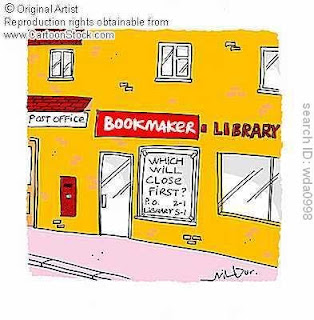
Recently my friend Thomas, a fellow librarian, posted this comic on Face book. I usually laugh heartily at Thomas’s postings, but this one is too true to be funny.

Given the ease and speed of e publishing, more “books" are being published than ever. A recent article by Mike Shatzkin points out, http://bit.ly/MW2knf ”half of the bookstore shelves that were available in the US in 2007 are gone by now.”

Handwritten letters are gifts; someone cared enough to sit down and share words of comfort, congratulations, birthday wishes, family news, or mail a postcard from Europe.  Who does that anymore?


Is print media dead?

I'm as guilty as the rest of you. I download books on my Kindle, and use Kindle and Nook apps on my phone and PC. But the nearest physical bookstore is an hour‘s drive from my house and sometimes I don’t want to wait two or three days to get a book in the mail from amazon, Powells or Barnes and Noble.


It's easy and fast to send e mail and catch up through social networking, yet it saddens me how the art of letter writing, handwritten cards and stamped paper envelopes may someday disappear.

Biographers often use old letters to carve out written portraits of their subjects. Through letters, authors are able to reproduce a subject’s voice, and recreate possible dialogue accurately. Imagine trying to track down electronic messages. For the past twenty years I have had numerous email accounts through my university days and several service providers. In the early days of the internet, service providers cropped up and disappeared with the seasons, so thousands of my communications are somewhere in cyberspace under addresses I no longer recall. Not that I will someday be worthy of a biography, but given the magnitude of social media, what will be worthy of existing in posterity?

Interesting how brick and mortar bookstores and libraries stores have only recently changed how they operate. While libraries still boast books as a major source of information, the shift toward multi media has not only oncreased circulation statistics, patrons expect to be able to find moivies, magazines, and music at the library. Similarly, patrons use library spaces for computer space.

For decades, books were the thrust of book stores. In the past few years I have noticed a trend toward games and gifts at the forefront and books displayed almost as an afterthought.

Books are my passion, one of the considerations for where to retire in three years is how many extant bookstores are nearby, yet

According yo Shatzkin, “One thing that will be different but similar in the rest of the world will be the decline of bookstores.”

Linda, another library colleague, suggested that maybe bookstores and/or libraries should have post offices and coffee shops in their lobbies. I love the idea of entities struggling to survive forge a symbiotic relationship. It happens in the natural worls all the time.

Meanwhile, the you can find world’s most interesting bookstores this site. They also sell hand crafted metal bookmarks and have links to lot of bookstore and library related stuff:


Your writing assignment this time is to write someone a letter or a card and mail it using snail mail. Then go visit the library.
Feel free to weigh in on this issue. Of course, you'll have to do it electronically, but there is room for multiple versions of comunication. When TV came out, people predicted it was the death of radio....
Happy Writing
@LauraMoewriter

Sunday, December 25, 2011

The Bookstore is Wounded, Not Dead

I am reading the most delightful book called The Yellow-Lighted Bookshop by Lewis Buzbee. Part memoir, part history of bookstores, the book confirms the existence of bibliophiles through the ages and the need to preserve extant book stores. True book lovers want more than just the book in our hands; we crave the entire experience of being surrounded by books and other book people. It’s so easy to download a book, but the aesthetic is thin and unsatisfying. Many writers were fostered by the presence of bound volumes, their heft and aroma, and the texture of words and illustrations on a page. Printed books have existed since ancient times, and these were not limited to religious texts and intellectual treatises. Even in ancient times, book buyers wanted romance and mystery. More evidence for the power of story and its place in human nature. Cave men craved story enough to carve into cave walls.

With the advent of e books and digitized media, story is not lost. The form has changed, just like we no longer carry clay tablets. Our tablets are bright, colorful and interactive, yet something feels lost. Reading on a tablet is a bit like dating a string of attractive people with whom you have little in common, but holding a book is coming back to an old lover with whom you have an enduring history.

I wonder about future generations, and how they will forge a bond with story that lingers. As much as the paperless society has been predicted, books published in paper form are tangible.

The publishing world is changing so fast even the “experts” don’t know what to expect. Independent authors are finding cheaper and easier means to get their work published and purchased. With KDP and Pubit and other e publishing venues, writers can upload text, design a cover, answer a few questions, and make their books available throughout the world. Granted, most self published writers should let their works simmer awhile and revise them before offering them up to a buying public. Do the ten thousand hours. But society is in a hurry, and the pursuit of instant fame and fortune is prevalent. Writers will never have a reality show, (though there is plenty of drama among writers). Perhaps readers want the illusion that the story writes itself and the writer and his/her life is secondary. A writer can be famous and anonymous at the same time. Other than Stephen King, can you picture your favorite author’s face?

There is room for multiple platforms, and my guess is kids reading stories on e books now will one day want to own a precious bound and illustrated volume of their favorite tale. The radio didn’t die when TV came out, and we though there is a junk food restaurant on every block, we still like a home cooked meal. Nothing feels like a book store. Other than the library, which is free, other stores will not let you hang out for hours and buy nothing. A coffee shop is close, but it’s missing books.

“When exploration and trade brought far corners of the world closer together-The Age of Exploration, The Age of Enlightenment, the Age of Rail, etc- there was a sharp rise in literacy. The ability to read was needed to keep up with the new technologies and business practices. And mandatory reading is always followed by elective reading. The more readers, the more books needed; more books, more bookstores.” (p.55, The Yellow-Lighted Bookshop)

Happy holidays, everyone. Yes, it is Christmas Day, but a writer never sleeps.


Happy Writing.