Showing posts with label libraries. Show all posts

Thursday, May 12, 2016

Feeling the Love, and I Don't Need a Map


My plane touches down late at night, or early in the morning to be exact. It’s been nearly a year since I’ve been back to Ohio after moving to the Seattle area. It’s familiar yet strange simultaneously.  At the car rental the desk clerk asked if I needed GPA. “No, I used to live around here,” I reply.

It feels nice to sit behind wheel and know where I’m going.

The next day, or rather later the same day, I drive east to Zanesville, the city I left behind last June. My first stop is to the public library where I had copies of my books sent. When I see the multiple boxes, I immediately know I ordered too many. The more books I ordered the larger my discount. But how would I get the ones that don't sell back to Washington? I head to Staples to mail two of the boxes back, canceling my discount.

I lunch with old friends, where we fall into conversation as if I’d never left. Next I am interviewed by the local newspaper (see link at the end of this post.). I had sent Jennifer an ARC, and it helped she had read my novel.

I need to go to the Dollar Store to buy some mouse and deodorant, but stop by Starbucks on a whim. As I chat with a familiar barista, a voice behind me shouts, “Don't serve that woman in here!” I turn, and my friend Myra is laughing behind me. She buys my coffee, and we sit and chat. The unusual thing here is she’s not surrounded by books and papers, and my laptop is in the trunk of my car.

I dine with another friend, and later, we meet up with my old book discussion group.
On Friday, I was supposed to give a presentation, but it was cancelled due to AP testing, so I’m relieved to have free time to spend with friends. The weekend breezes by with meals and coffee with old friends, signing books for many who pre-ordered copies. (My friend Cindy S and I correct a crime of punctuation.)


On Monday I crash the semi annual meeting of library training. Trish, the facilitator, knew I planned to stop by, but she didn't tell my colleagues. I step inide and it seems they are on break. I spot Becky, my former assistant, at a front table. I approach and indicate the empty chair next to her. “Is this seat taken?” I ask. She doesn't look up immediately, but when she sees me she breaks into a groin and we hug. We end up having a three hour lunch before I head to Columbus for my first official book signing.

There’s a critical scene in BREAKFAST WITH NERUDA that takes place in The Book Loft, where my reading is being held. I had a small but appreciative audience, including a couple of fold chums I had not seen in person in twenty years. (Yeah, this pic didn't save right.


Tuesday morning I meet with yet another friend before heading to Maysville High school to talk with students, reconnect with former colleagues, and sign books. My friends Myra and Cindy had arranged a nice luncheon for a couple of classes. Here I am with a couple of fans.


The last stop on my whirlwind Ohio tour is the John Mcintire Library in downtown Zanesville. The turnout is excellent, with the audience comprising of friends and former students and colleagues. (This photo of Jackie Kaser and I shows up correctly in my files, but not here, so you have to tilt your head to the right. )


I spend the night in Columbus because I have an early flight. I leave Ohio again with mixed emotions. It’s as if I belong in two places now, yet I’ve always felt at home in the world. Maybe a life of living on the move enables me find comfort where I set my hat.


I’m back in Washington now, where I make my home. Pablo is glad to see me. Usually he ignores me as a cat is wont to do, but he’s been at my side since I walked in and dumped my bags yesterday afternoon.


http://www.zanesvilletimesrecorder.com/story/news/local/2016/05/07/former-teacher-hopes-reach-young-readers-novels/84066952/

Sunday, June 8, 2014

Mr. Dog Bites on June 10


Amidst the cacophony of derivative, dystopian YA fiction emerges a unique and original tale in When Mr. Dog Bites, a forthcoming YA novel by Brian Conaghan. The hero of the tale is sixteen year-old Dylan Mint, a boy who attends Drumhill, or as he calls it, the ‘school for spazzies.’ His best friend, Amir suffers from mild Asperger’s and a stutter, and because he is Pakistani, is often a bully target. Dylan himself has Tourette’s, and his outbursts often get him into trouble. At the outset of the story Dylan believes he has only months to live after he overhears a conversation between his mother and a doctor, when the doc says,” life as he knows it will end in March.” Dylan begins a quest of “Cool things to do before I cack it,” which include having sex with a girl named Michele Malloy, finding a new best friend for Amir, and helping get his dad back from the war. Given these herculean tasks, Dylan’s odyssey is often funny, and ultimately transformative.

Dylan’s voice is engaging, and the diction and interior dialogue are inventive and reminiscent of Kerouac, such as “I was better off taking the hind arms off a brick wall”, [the teacher] “sometimes … treated us like a mad shower of window lickers,” [his mom’s eyes] “were like a butter knife to my heart,” and “I want to Usain Bolt out of here.” A large chunk of the book is in dialogue, and while I found most of it engaging, I missed Dylan’s interior voice.  Conaghan skillfully creates a likable, realistic character in Dylan without forcing the reader to feel sorry for him and his situation.

As an adult, and a secondary school librarian/teacher of many years, the profanity did not bother me, but this book may have a hard time finding shelf space in school libraries, which is unfortunate.  The words Dylan yells are nothing kids don’t hear in the hallways any given day, and all kids need to live inside the head of a character whose thought patterns may differ, yet still has the same human desires of love and belonging. Besides, part of Tourette’s includes involuntary eruptions of swear words. If Congahan, who acknowledges he too has Tourette’s, had sanitized Dylan’s tics and outbursts, he would lose credibility as a writer. This book can do much to clarify Tourette’s as The Curious Incident of the Dog in the Night did for Autism. YA fans of John Green, David Levithan and Kody Keplinger will enjoy When Mr. Dog Bites.


Happy Reading.

Saturday, September 28, 2013

Should We Ban Books in School Libraries?


Here is my final installment of my Banned Books Week posting. This post is excerpted from a section of my Master’s thesis on censorship in school libraries from more than twenty years ago. My opinion has not changed. Some content has been edited and updated, but not censored.

Censorship in schools did not begin with Catcher in the Rye. In The Republic, Plato proposed to banish poets and dramatists for the making the Gods look less than God-like. He wrote that fiction had a band moral influence on the young. This ideology laid the groundwork for today’s justification for removing books from school libraries..

During the nineteenth century, Anthony Comstock, a zealous fundamentalist, penned a book entitled Traps for the Young, noting that light literature, newspapers and artistic works, including literature, were traps. He believed anyone who read “dime novels,” today’s equivalent to Young Adult, was doomed to a life of degradation and Hell.

Censors often have not read the materials which they challenge, or have only read isolated passages out of context. An example of a ludicrous dispute is the often challenged Steinbeck novel The Red Pony. In the 1980’s, the Vernon-Verona school District labeled the book as “a filthy and trashy sex novel.” If the challengers had bothered to read the book, they would learn this particular work by Steinbeck is a clean-cut tale of a boy and his horse. Because Steinbeck, who also authored East of Eden and The Grapes of Wrath wrote The Red Pony the assumption is made that this, too contained questionable materials, yet this book continues to appear on banned book lists.

Censors believe book have behavioral consequences leading to premarital sex, violence, and questioning authority.  The two most often censored aspects of books are language and sex, the fear being that teenagers will emulate behavior of the characters in the book such as Holden Caulfield in Catcher in the Rye. Teens hear this language every day in the hallways at school, or if they have jobs, out in the real world.

These same censors do not give students enough credit for their ability to discern when language is appropriate or not. Students know literature and real life are different. It doesn’t mean the words themselves should be emulated, and students who use an F-bomb or other curse word in class are usually punished, but colorful vocabulary is a part of life. If authors sanitized their dialogue by substituting expletives with phrases like “Oh, fudge!,” or “Drat and  Sugar” they lose credibility with their readers.  Young adult author Robin Brancato states, “…when I employ ‘bad language’ as you call it, and references to sex, it is not because I think these are needed to sell books or hold the reader’s interest, but because the body functions and the names for them, both polite and impolite, are parts of life, and I am interested in portraying life as it really is.”

Almost no literature is without sex. The Bible, beginning with Adam and Eve, is loaded with sex and sexual references, thus making it also a contested book in many libraries.

A distinction must be made between pornography and literature. Pornography is a Latin term meaning ‘writing about prostitution.’ In modern times, pornography has devolved into sub-literature comprising endless repetition, stilted dialogue and is most often anonymously written. Unlike literature, pornography’s intent is not to evoke realistic emotion or feeling; it is merely designed to titillate.

In the not too distant past librarians themselves were the primary censors. In early volumes of the American Library Journal, censorship was encourages through articles written about the dangers of certain types of books, particularly fiction. It was not until the Library Bill of Rights was adopted in 1939 that a clear cut policy was adopted.

The most ironic challenge is Fahrenheit 451, a book about book burning books. Written in the early Fifties about a futuristic world (which eerily resembles us today with our ear buds and wall sized TVs), fireman are dispatched to homes where the owners are known to have books, in effect, destroying all intellectual knowledge.

The purpose of education is to not only communicate factual information, but to teach young people to be critical thinkers who can devise their own value systems. Censorship undermines the students’ ability to discriminate.

Al school libraries have criteria for selection of new materials. Some might argue that selection is a form of censorship, yet school libraries are constrained by curricular needs and tight budgets. It becomes a problem when librarians either enforce their own narrow fields of interest, or when community or administrators question materials available through the library/media center. A library media specialist’s responsibility is not to impose his or her viewpoints on patrons. A colleague once told she weeded the Negro Almanac because the term ‘negro’ offended her. Granted the title is dated, and if one has the budget to replace this with a suitable, updated source, then go for it. But I will defend keeping a book like this on the shelf for the information and historical perspective it contains. Our culture likes to pretend the Unites States does not have an ugly past.

There are no easy answers for the question of censorship. I consider myself open minded, but, I too have limits. I will not intentionally stock an item on my shelves which encourages or instructs a students on how to kill himself.  Nor will I add blatantly graphic works such as Madonna’s Sex book or Fifty Shades of Gray.  However, there are materials in my library which offend my intellect: the schlocky, badly written vampire romances or the ever popular, badly written child abuse memoir, The Lost Boy. Kids love them, and it’s not my place to judge what students choose to read. My goal is that students read, period. Once the seeds for story are planted, perhaps kids will gravitate towards higher quality literature. In any case, they will have the freedom of choice.


Happy Reading and Writing.

Thursday, January 17, 2013

Is Print Dead?

Available now 


.
Shortly after Christmas I visited Barnes & Noble. I spent a lovely afternoon having a latte in the cafe and  browsing the shelves. I walked to the registers to pay for my purchases. As I stood in line, I perused the magazines racks near the counter, and was stunned by the banner across Newsweek: This is Our Last print issue. Something in me shifted; science fiction is no longer fiction.
 Those of you who subscribe to and read my blog regularly know of my ambivalence with emerging technologies, particularly in the book realm. I own several devices, and use them regularly. I composed The draft for this post on an iPad, so arguing against technology is moot. However, my argument is not to ban existing platforms, as is happening in this Texas library,  http://news.yahoo.com/library-without-books-bibliotech-open-193118588--abc-news-tech.html

Is this a trend? The library of the future?  Look at the accompanying illustration in the artcile. What do you notice about the people? There are none, only a series of screens and empty stools. The shadowy figure behind the desk is solitary. Does that mean libraries will not only do away with printed matter, but their staffs as well?


Libraries throughout the centuries have adapted to the needs of their clientele. Every few years the death of the library is predicted, yet libraries have demonstrated a perseverance and adaptability. Yet this latest shift could put a serious dent in library services.

(Bookstores, however, are experiencing a shakier fate. see

Probably a gazillion of us have some access to screen technology, be it a TV, computer, laptop, smart phone, e reader, or tablet. I use all of the above to some extent, yet there is an aesthetic to printed books not found with a digital version. Perhaps this reveals my age. I grew up in a time before reliance on cell phones dominated our lives, relatively un-tethered to friends and family if I ventured out alone. Now I can update my status 24-7 via Facebook, revealing what I ate for dinner , find the weather and upcoming TV listings on my phone, yet when I use my e reader, Big Brother knows what I am reading.

E readers are great for travel. When I take a trip more than three days long, I generally like to pack 3-4 books, which now that airlines charge us for every last speck of dust in our luggage, loading a variety of books on my Kindle makes sense. The device is about the size of a trade paperback, and weighs about the same as a hardback book.

My Kindle is the second generation, which does not have a backlit screen, yet,  there are some issues with reading from backlit technology, particularly at night, the blue spectrum light emitted by screens interrupts sleep patterns. http://www.medicalnewstoday.com/articles/249592.php

This is bad news for those of you who like to curl up with your iPad or Kindle Fire and read in bed.  

 I don't hate technology. It enables me to write and post this readers in a variety of places, twitter, Google plus, and Facebook. In the old days, before blogging, when all opinion pieces  were printed through edited means, my ideas would be limited to cocktail hour chats or perhaps a letter to the editor. Now I can have a global dialogue and Instant access to feedback.

Another ironic bonus to technology is instant books.  I live an hour's drive from a brick and mortar bookstore, so if I need or want a book right away, I download it. Recently a publication where one of my stories appears (Triskaidekan,) was delayed by the printer, (see photo at top.) but the publisher posted an e book version, and I gained instant access to the anthology, which I was able to promote via social networking. Yet I still plan to also order a printed copy.

Ironically, readership is on the rise, yet print media are declining. It's the chicken or the egg. (Is digital downloading of books on the rapid rise due to vanishing bookstores, or are book stories vanishing because of digitalization? But this post isn’t supposed to be about bookstores…)  According to the Pew Research  Center , “The popularity of electronic books is increasing in the United States, with nearly one-quarter of American bibliophiles reading e-books, according to a survey released on Thursday…The number of e-readers aged 16 years and older jumped from 16 percent in 2011 to 23 percent this year, while print readers fell from 72 to 67 percent in 2012.”

But technology has its limits. Things break down. The power goes out, security leaks, files corrupted, devices get lost, or stolen, (who steals books anymore?) screens break, or go wonky. There are also economic issues.  . I live in Appalachia, where 45% of our students qualify for free and reduced lunched.  Many of our students in my HS still do not have access to computers and the Internet outside of school. Checking out books is free.


Lets hope the death of printed matter becomes, like the predicted death of radio with the advent of television, a shift n emphasis, where books and gadgets forge an alliance rather than declare war.

Please visit your local Library. Ask for information. Check out a book or other printed media. 

Thursday, September 6, 2012

The Odds Are Not Great Either Way


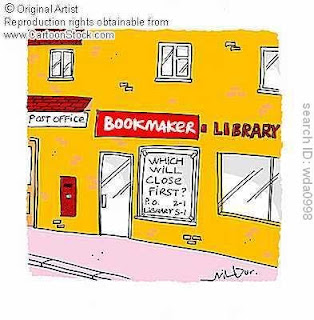
Recently my friend Thomas, a fellow librarian, posted this comic on Face book. I usually laugh heartily at Thomas’s postings, but this one is too true to be funny.

Given the ease and speed of e publishing, more “books" are being published than ever. A recent article by Mike Shatzkin points out, http://bit.ly/MW2knf ”half of the bookstore shelves that were available in the US in 2007 are gone by now.”

Handwritten letters are gifts; someone cared enough to sit down and share words of comfort, congratulations, birthday wishes, family news, or mail a postcard from Europe.  Who does that anymore?


Is print media dead?

I'm as guilty as the rest of you. I download books on my Kindle, and use Kindle and Nook apps on my phone and PC. But the nearest physical bookstore is an hour‘s drive from my house and sometimes I don’t want to wait two or three days to get a book in the mail from amazon, Powells or Barnes and Noble.


It's easy and fast to send e mail and catch up through social networking, yet it saddens me how the art of letter writing, handwritten cards and stamped paper envelopes may someday disappear.

Biographers often use old letters to carve out written portraits of their subjects. Through letters, authors are able to reproduce a subject’s voice, and recreate possible dialogue accurately. Imagine trying to track down electronic messages. For the past twenty years I have had numerous email accounts through my university days and several service providers. In the early days of the internet, service providers cropped up and disappeared with the seasons, so thousands of my communications are somewhere in cyberspace under addresses I no longer recall. Not that I will someday be worthy of a biography, but given the magnitude of social media, what will be worthy of existing in posterity?

Interesting how brick and mortar bookstores and libraries stores have only recently changed how they operate. While libraries still boast books as a major source of information, the shift toward multi media has not only oncreased circulation statistics, patrons expect to be able to find moivies, magazines, and music at the library. Similarly, patrons use library spaces for computer space.

For decades, books were the thrust of book stores. In the past few years I have noticed a trend toward games and gifts at the forefront and books displayed almost as an afterthought.

Books are my passion, one of the considerations for where to retire in three years is how many extant bookstores are nearby, yet

According yo Shatzkin, “One thing that will be different but similar in the rest of the world will be the decline of bookstores.”

Linda, another library colleague, suggested that maybe bookstores and/or libraries should have post offices and coffee shops in their lobbies. I love the idea of entities struggling to survive forge a symbiotic relationship. It happens in the natural worls all the time.

Meanwhile, the you can find world’s most interesting bookstores this site. They also sell hand crafted metal bookmarks and have links to lot of bookstore and library related stuff:


Your writing assignment this time is to write someone a letter or a card and mail it using snail mail. Then go visit the library.
Feel free to weigh in on this issue. Of course, you'll have to do it electronically, but there is room for multiple versions of comunication. When TV came out, people predicted it was the death of radio....
Happy Writing
@LauraMoewriter